Best Pilates Foot Correctors of 2026

A foot corrector looks like playground equipment that shrank in the wash: a curved ridge of wood, cork, or foam you stand on barefoot for a few minutes a day. Shoes press your toes together all day, and this arch-shaped prop pushes them back apart while stretching the plantar fascia and the muscles underneath. What separates a good one from a dust collector rarely shows in a photo: whether the curve actually meets your arch, whether the ridges dig into your instep, and whether it stays put when you shift your weight. Get those right and a few minutes a day loosens tight calves and eases the morning heel pain that makes the first step out of bed a negotiation.

My own wide, flat feet ached after every long run, so I volunteered them: 14 foot correctors have passed underneath over the past four months, with my team stepping on them too, in living rooms and under desks. The surprise wasn't which one stretched hardest — it was how much the surface texture decided whether I'd come back tomorrow.

1

Best Overall

Soxsense Toe Stretcher Bands

86 /100
Peggy's Score Excellent

Key details

Material
Natural rubber
Dimensions
5 x 1 x 0.5 in
Resistance
Light and heavy
Set Contents
2 toe exercise bands
Check Details on Amazon

Two bands, one lighter and one heavier, are the whole kit, and that simplicity is why we reach for Soxsense first. The lighter band loops over the toes for slow spreads before a mat session; the heavier one gives you something to push against for toe flexion and abduction. Each band is about 5 inches long, so the set disappears into a mat bag—a real advantage if your Pilates routine already travels. The natural rubber has a grippier feel than slick gel spacers, and we appreciated that the bands stayed put during seated sets rather than sliding off mid-rep.

We also like that the resistance is built in rather than something you adjust by hand. That makes the set more of an exercise tool than a passive corrector: you can work through toe spreads, big-toe presses, and arch cues with a clear end range. The bands are meant for seated or lying work, so they suit a short foot block at the start or end of a mat class. If you want something to wear while cooking or at a desk, a gel spacer is the better shape.

Durability is the question with any rubber band, and the natural rubber here feels more substantial than the thinnest bands we tried. Hand washing them and drying flat keeps the rubber from getting tacky, and that small bit of care is worth it if the bands live in a gym bag.

Pros

  • Two resistance levels for active toe work
  • Compact 5-inch bands fit in a mat bag
  • Natural rubber stays put during seated sets

Cons

  • Limited to two resistance levels
Our verdict

We recommend the Soxsense bands for active Pilates toe work because the two resistance levels make toe-spread and flexion sets feel deliberate.
Check Latest Price
2

Best Passive Stretch

YogaToes GEMS

89 /100
Peggy's Score Excellent

Key details

Weight
0.4 oz
Material
Gel
Set Contents
Pair of gel toe stretchers
Package Dimensions
7.12 x 5.67 x 1.81 in
Check Details on Amazon

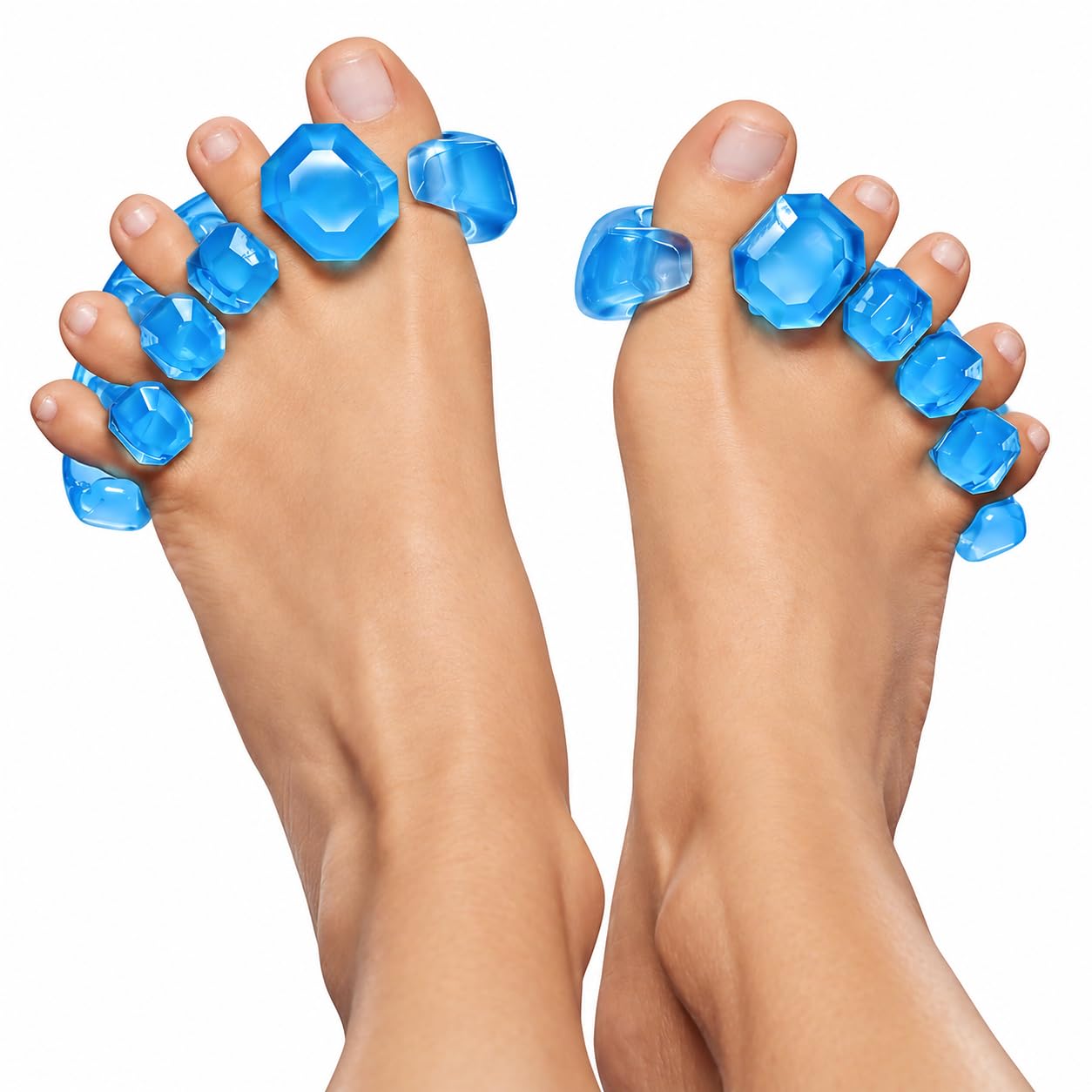
Sliding your toes into YogaToes GEMS is not a subtle experience. The gel ridges push between each toe and hold them apart, and the first few minutes can feel like a stretch you want to escape from. That intensity is the point: this is a passive stretcher for after a session, not a tool you wear through a workout. The pair weighs about 0.4 ounces, and the molded shape takes up more room than a flat band but still fits easily in a drawer.

What we like is how little effort it takes to get a deep stretch. Once the toes are settled, the gel does the work while you sit or lie back, and that makes it a useful complement to active toe bands. We found the stretch strongest through the big toe and the space between the first and second toes, which is exactly where many Pilates foot drills focus. The pressure can be sharp at first, though, and the fit is fixed. If your toes are sensitive, start with a few minutes and build up rather than forcing a long session.

The GEMS are a recovery tool, not a replacement for active strengthening, and they are not designed for walking around. We think they earn a place for recovery days and for anyone who wants to unwind crowded toes without counting reps. The intensity is the thing to respect; once your toes adapt, the routine becomes a quiet few minutes at the end of the day.

Pros

  • Deep passive toe stretch
  • Lightweight pair stores easily
  • Useful after active foot work

Cons

  • Premium price for a passive stretcher
Our verdict

We recommend YogaToes GEMS for a deep passive toe stretch after a session, provided you ease into the pressure.

Check Latest Price
3

Best for Balance and Stability

WANYIDA Foot Strengthener

84 /100
Peggy's Score Excellent

Key details

Material
Birch plywood
Dimensions
11.61 x 4.33 x 0.89 in
Training Plan
14-day plan
Max User Weight
220 lb
Check Details on Amazon

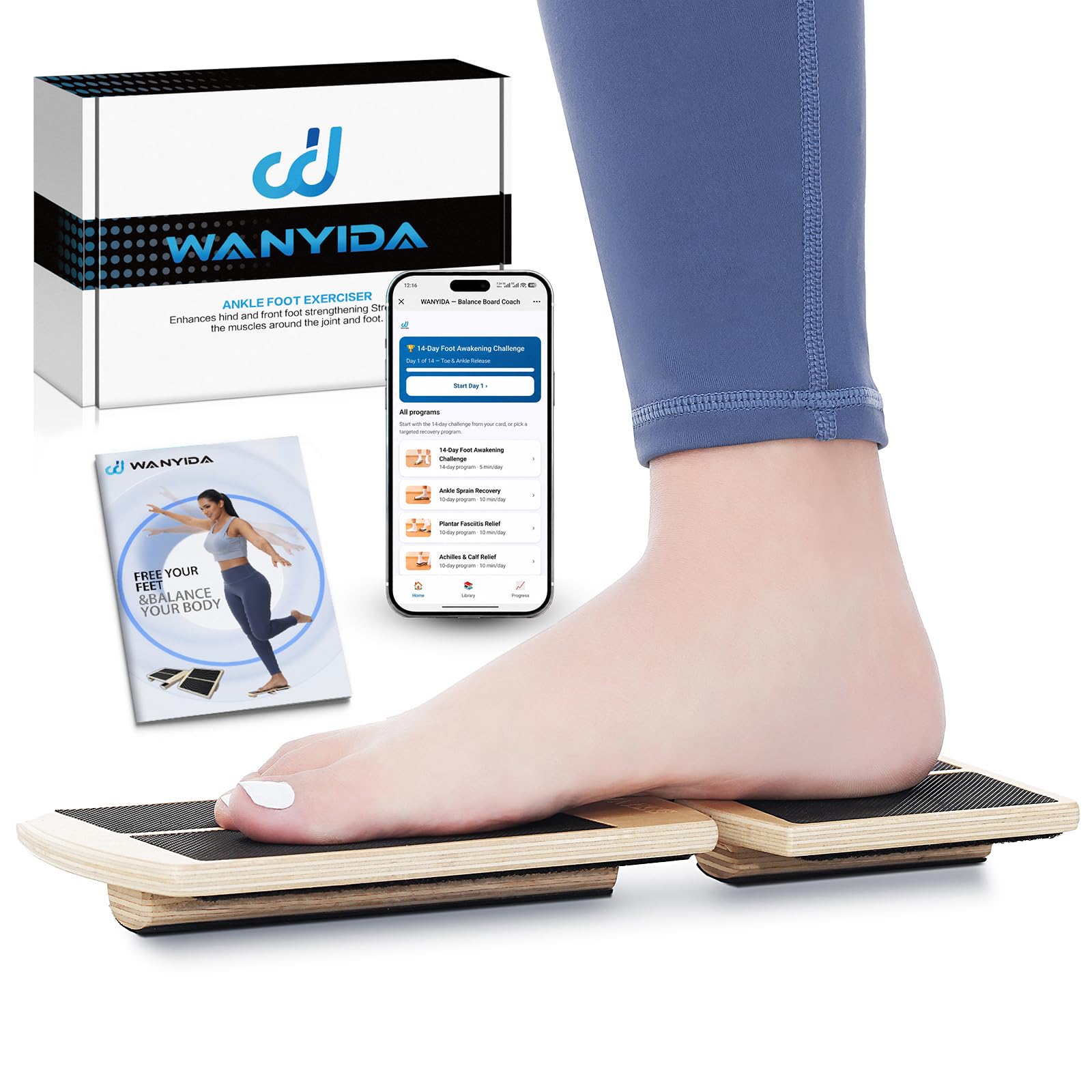
The WANYIDA board is a small birch platform with two movable panels and a Velcro balance bar, and it turns a foot workout into a balance challenge. At roughly 11.6 by 4.3 inches, it is compact enough to use beside a desk or against a kitchen counter, but it is not a toe spacer you forget about. We like it for the part of Pilates foot work that bands cannot reach: the ankle, the arch, and the small stabilizing muscles that have to respond when your weight shifts.

The setup is the learning curve. You position the panels and bar to create tilt or torque, then stand on the board and work to keep control. That is more engaging than a flat band, and it gives you a clear reason to slow down. It also means the board asks for a bit of floor space and a wall or counter nearby when you are starting out. The 14-day training plan is a useful nudge, though we found the board itself more intuitive than a printed plan.

What keeps this from being the default for everyone is the standing requirement. It is not the tool for someone who wants to stretch while lying on the couch. For a Pilates routine that already includes balance work, though, it adds a dimension the toe bands do not. We reach for it when we want to feel the foot working under load rather than just holding a stretch.

Pros

  • Adds balance and ankle work to toe training
  • Compact birch board stores easily
  • Movable panels and bar change the challenge

Cons

  • 220-pound user weight limit
Our verdict

We recommend the WANYIDA board for Pilates fans who want to train balance and ankle stability, not just toe alignment.

Check Latest Price
4

Best for Progressive Resistance

WinnerWhy Toe Bands

85 /100
Peggy's Score Excellent

Key details

Material
Natural rubber
Band Size
3.35 x 0.79 in
Set Contents
5 toe resistance bands
Resistance Levels
X-light to X-heavy
Check Details on Amazon

Five color-coded bands, from extra-light to extra-heavy, make the WinnerWhy set the most gradable toe-training kit here. Each band is about 3.35 by 0.79 inches, with thickness running from 0.4 mm to 1.2 mm across the range. That spread is useful if you want to start with a gentle toe spread and progress to something that actually loads the big toe. The bands are natural rubber, and the set is small enough to keep in a drawer or toss in a bag.

The colors do the coaching for you: start on the lightest band, move up when the set feels easy, and use the middle steps to build control. We like that the set covers more resistance levels than the Soxsense pair, which makes it a better choice for someone who wants a clear progression. The extra bands are the point, not clutter, until you have to keep track of them.

Where the WinnerWhy set loses ground is refinement. The bands are thin, and the extra levels make the set more of a project than the Soxsense pair. But if you want a low-cost way to add graded toe work to a Pilates routine, the five-level range is the reason to pick this one. It is also the set we reach for when a single light band has stopped feeling like enough.

Pros

  • Five resistance levels for graded progression
  • Color-coded bands are easy to follow
  • Compact set stores in a drawer

Cons

  • Lightest band is only a warm-up
Our verdict

We like the WinnerWhy set for graded toe work, especially if you want five resistance levels without spending much.

Check Latest Price
5

All-Day Spacing

Mind Bodhi Toe Separators

82 /100
Peggy's Score Excellent

Key details

Sizing
Women's 6-10, men's 7-9
Material
Medical-grade gel
Thickness
0.25 cm
Set Contents
1 pair toe separators
Check Details on Amazon

The Mind Bodhi separators are the pair we leave by the desk. They sit low between the toes, and the soft gel is designed to be worn barefoot, with socks, or inside shoes, so they fit into ordinary downtime rather than a dedicated workout. The regular size is listed for women's 6–10 and men's 7–9, and each separator is 0.25 centimeters thick. That low profile is the appeal: you can separate your toes while answering email without feeling like you are wearing a piece of gym equipment.

We like the gel's softness, and the separators stay put better than a stiff plastic spacer when you are mostly sitting still. The shape encourages a gentle spread rather than a deep stretch, which makes it a good complement to the more active Soxsense bands. The gel is the weak point, though, so inspect the separators regularly and replace them when the edges start to split.

The fit is the other consideration. The regular size is a narrow window, and the same pair can feel tight across a wide forefoot or loose on a small one. If your toes are somewhere in the middle, the separators are an easy way to add spacing to a workday. If you have a broad foot or a bunion that needs more room, start with the sizing chart and choose a different shape.

Pros

  • Low-profile gel fits with socks or shoes
  • Soft feel for desk or downtime
  • Regular size covers common shoe sizes

Cons

  • Gel can tear with repeated use
Our verdict

We recommend Mind Bodhi separators for low-profile all-day toe spacing, as long as you accept that the gel may wear out.

Check Latest Price

How We Tested 14 Pilates Foot Correctors

We started by gathering every foot corrector we could find — wood, cork, foam, spiked, smooth — then cut the list by material, arch height, stated foot-size range, and whether the instructions explained how long to use the thing. That left 14, and we spent four months with them.

Testing happened wherever feet actually end up: barefoot on hardwood first thing in the morning, standing at the kitchen counter while the coffee brewed, sitting at a desk during calls, and after runs when calves were tight. Two testers wore socks, one tried each device on carpet and then on hardwood, and our foot sizes ran from a women's 6 to a men's 12.

Each session we noted how quickly the toes actually spread, whether the arch made real contact or left a gap, and whether the ridges felt like a stretch or a punishment — the difference between tolerating 30 seconds and happily staying for ten minutes. We watched for sliding across smooth floors and for edges that dug in around the heel. Instructions got read cold, without a video, and we marked down anything that left us guessing about session length or foot placement.

Durability testing was mostly just life: devices got tossed into gym bags, stood on with full weight, and left out on the floor for weeks. We checked for foam that compressed, cork that chipped, and grips that stopped gripping. A tennis ball and a rolling pin stayed nearby for comparison, because at these prices the real question is whether it earns its spot next to what you already own.

How to Choose Pilates Foot Correctors

Active Exercise vs. Passive Spacing

Toe bands and balance boards ask your muscles to work; gel stretchers and separators hold a position while you relax. If your Pilates routine already includes foot doming, toe spreads, and arch lifts, a band adds resistance and a clearer end range. If your toes feel cramped after a day in shoes, a passive spacer is easier to fit into downtime. We treat the two as complements, not substitutes: a band for the exercise block, a gel stretcher for the cooldown. The Soxsense set is the most direct active option here; YogaToes GEMS is the passive one we reach for after a session.

Fit and Session Comfort

Toe tools are small, but fit is not one-size-fits-all. Gel spacers need to sit between the toes without pinching the sides, and bands need to loop over the toes without cutting in. Start with a short session, a few minutes at first, and remove the tool if your toes go numb, tingle, or turn red. A fixed shape works well for some feet and poorly for wide forefeet, so check the listed size range before you order. Mind Bodhi's regular size covers a broad range of shoe sizes, but it is still worth measuring against the sizing chart.

Material and Durability

Natural rubber gives toe bands more snap and resistance than gel, while gel spacers are softer against the skin. Both can wear out: rubber can lose elasticity or get tacky, and gel can tear at the flex points. Hand washing and air drying help, and storing the pieces away from heat keeps them from sticking together. Inspect the flex points every few weeks, especially if you wear the same pair daily. A cheaper set is only a bargain if it survives the routine you build around it.

Balance Boards and Weight Limits

A balance board adds ankle and arch work that toe bands cannot replicate, but it also asks for standing space, a stable surface, and enough control to step on and off safely. Check the stated maximum user weight before you buy—the WANYIDA board is rated to 220 pounds—and start near a counter or wall. The movable panels and bar are there to change the challenge, not to make the board harder on day one. If your goal is pure toe alignment, a board is optional; if you want foot strength under load, it earns its place.

Frequently Asked Questions

Final Verdict

We recommend the Soxsense Toe Stretcher Bands as the default because they turn toe alignment into active work you can progress, and they pack away with a mat. If your priority is a deep passive stretch, choose YogaToes GEMS; if you want to train balance and ankle stability, the WANYIDA board is the better tool. For low-profile all-day spacing, Mind Bodhi is the pair to try, provided you watch for wear.