Best Kettlebell Sets of 2026

A kettlebell is the smallest gym you can own: one bell, a patch of floor, and you've got swings, goblet squats, cleans, and carries. The catch is that one bell isn't enough — light for warm-ups and technique work, heavy for swings, something in between for everything else. Buying them one at a time gets expensive, and a full rack eats floor space you may not have.

My team and I spent six months swinging, cleaning, pressing, and dropping 12 kettlebell sets, from single cast-iron bells to dial-based adjustables that stand in for half a rack. What separated them wasn't the marketing. It was whether the handle fit a real hand without shredding it, whether the stated weight was actually the weight, and whether the coating survived being set down hard on a concrete floor.

Worth knowing before you shop: adjustable bells trade a moving part for the space savings, while a fixed set trades space for nothing that can fail. Neither approach is wrong — it comes down to whether your limit is square footage or budget. The picks below cover both, plus the handle widths, coatings, and storage setups that held up.

1

Best Overall

BowFlex SelectTech 840

96 /100
Peggy's Score Outstanding

Key details

Warranty
2 years
Footprint
8.82 by 7.01 inches
Handle Diameter
28 mm
Weight Settings
Six, from 8 to 40 lb
Check Details on Amazon

Six kettlebells take up the floor of a room. The SelectTech 840 puts the same six weights — 8, 12, 20, 25, 35, and 40 pounds — into a single bell that changes with a turn of the dial. In an apartment, or a living room that doubles as a gym, that is the entire argument, and it is a good one.

We kept coming back to it because the ladder is the one most home lifters actually climb. Eight and 12 pounds are where pressing, halos, and get-up practice start; the jump to 20 is the one you feel; 35 and 40 are real swing weights. Settings change with the bell sitting flat on the floor, which matters more than it sounds when you're alternating a press with a swing and don't want to break rhythm.

What you give up is shape. The body is taller and boxier than a cast iron bell, so a clean that finishes against the forearm sits differently, and passing it under a leg takes more clearance than you expect. We noticed it most on wrist-heavy movements and not at all on swings, rows, squats, or presses. The composite shell also means this is not a bell to drop. Set it down.

A 28 mm handle and a two-year warranty round it out; the bundled JRNY trial is not why anyone buys this bell.

Pros

  • Six weights from 8 to 40 lb in one bell
  • Dial changes without breaking rhythm
  • Fits a closet instead of needing a rack

Cons

  • Taller, boxier body than a cast iron bell
  • Composite shell should never be dropped
Our verdict

We recommend it to anyone building a home gym in a room they also live in: six weights, one footprint, and a handle that takes two hands.

Check Latest Price
2

Best Cast Iron Set

REP Fitness Kettlebell Set

94 /100
Peggy's Score Outstanding

Key details

Sold As
Singles or sets
Weight Range
4 to 24 kg (9 to 53 lb)
Handle Finish
Smooth, seam-free
Handle Diameter
1.18 inches
Check Details on Amazon

The handle is where a cast iron bell earns its money, and REP's is the best we handled in this group: 1.18 inches across, smooth and seam-free, textured just enough in the finish to hold without chalk and not enough to chew a callus. Two-handed swings don't pinch, and the machined flat base sits still on a wood floor instead of rocking.

The range runs from 4 kg to 24 kg (9 to 53 lb), and REP sells singles as well as sets, which changes the arithmetic. You can buy the pair you swing now and add a bell each time you stall, rather than paying for five at once or replacing a starter set you outgrow. For someone already committed to kettlebells, that's the smarter way to spend this much money.

It's a lifter's set rather than a beginner's: 9 pounds is the floor, so overhead pressing for a new user starts heavier than ideal, and the top bell will outlast most people's ambition. Between those ends, this is the one we reach for when we want a clean to feel the way it does in a gym.

Pros

  • Smooth, seam-free 1.18-inch handle
  • Range from 9 to 53 lb
  • Sold as singles or sets to grow

Cons

  • Powder coat chips where bells knock together
  • Costs more than most home lifters will spend
Our verdict

We recommend it to lifters who already know they'll stay with kettlebells: buy the pair you swing now and add bells as you go.

Check Latest Price
3

Best Value Cast Iron

Unipack Powder-Coated Set

93 /100
Peggy's Score Outstanding

Key details

Base
Machined flat bottom
Finish
Powder coated
Material
Solid cast iron
Set Includes
5, 10, 15, 20, 25 lb
Check Details on Amazon

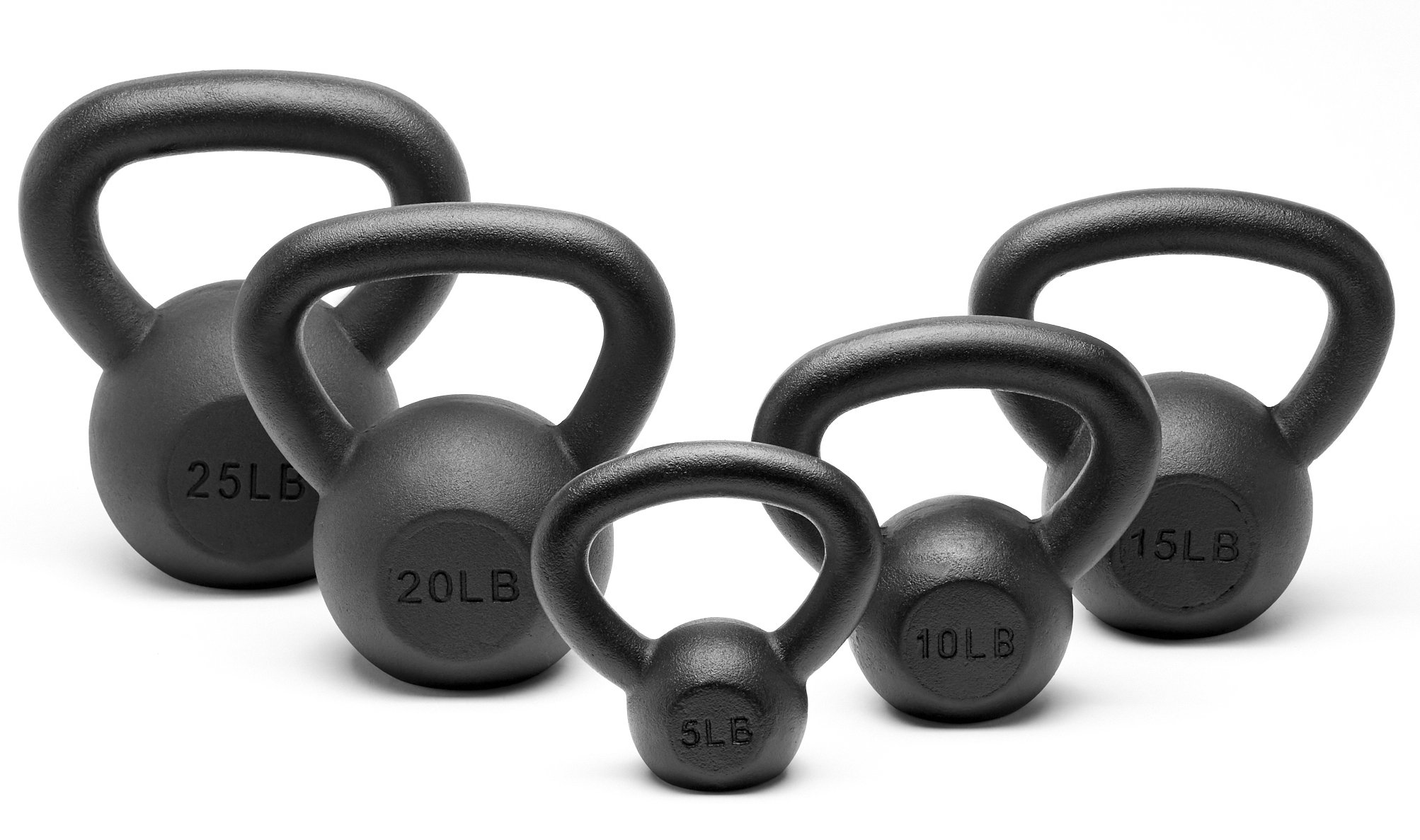
Five bells — 5, 10, 15, 20, and 25 pounds — arrive in one box, which is a different proposition from an adjustable: nothing to load, nothing to lock, nothing to think about between sets. Each one is solid cast iron with no welds or seams, powder coated, with a machined flat bottom.

We like the increments. Five pounds between bells is the right gap for pressing, rows, and goblet squats, where a 10-pound jump changes the movement rather than just the effort. Every bell is marked in pounds on both sides, so a mismatched pair is obvious on the rack, and the flat bottoms stand up instead of rolling under the couch.

The ceiling is 25 pounds, which is a swing weight for a strong beginner and a warm-up for everyone else. If you already swing 35 or 40, this set stops short and the REP set or a heavier adjustable is the better spend. For a first home rack — or a household where two people lift at different levels — five cast iron bells at this price is the best value in this group.

Pros

  • Five cast iron bells from 5 to 25 lb
  • Powder coat grips without chalk
  • Machined flat bottoms stand upright

Cons

  • Stops at 25 lb
  • Powder coat can chip at contact points
Our verdict

We recommend it to anyone building a first home rack who wants cast iron, real five-pound jumps, and a set that won't need replacing when the paint wears.

Check Latest Price
4

Best Budget Adjustable

Yes4All Adjustable Kettlebell

91 /100
Peggy's Score Outstanding

Key details

Plates
Cast iron
Dimensions
10.62 by 9.06 by 13.39 inches
Handle Diameter
1.2 inches
Weight Settings
Seven, from 7.8 to 40 lb
Check Details on Amazon

The cheaper adjustable bell costs less for a reason, and most of that reason is the mechanism. Where the BowFlex turns a dial, this one has you load cast iron plates onto the core and lock them with a lever. That's a two-step job instead of a one-step job, in exchange for a price that sits well under the dial bell.

Seven settings run from 7.8 to 40 pounds, and the plates carry visible markings so you can see what you've built without counting. We found the routine quick enough once we had done it a few times, and the wide, non-slip handle takes two hands comfortably. The flat base lets the whole thing stand upright in a closet between sessions.

Weight accuracy is the thing to check. The plate math doesn't always land precisely on the marked total, so if you're running a program with fixed jumps, put the assembled bell on a scale once and write the real number on a card. For everything else the marked weight is close enough, and seven settings for this money is why it's here.

Pros

  • Seven settings from 7.8 to 40 lb
  • Cast iron plates, not a composite shell
  • Wide handle and upright storage

Cons

  • Plate loading is slower than a dial
  • Marked totals can run a little off
Our verdict

We like it as a first adjustable: seven cast iron settings to 40 pounds for well under the dial bell, as long as you don't need the marked weight to be exact.

Check Latest Price
5

Best for Heavy Swings

RitFit Neoprene Set

92 /100
Peggy's Score Outstanding

Key details

Base
Flat bottom
Coating
Neoprene
Set Includes
20, 25, 30, 40, 45 lb
Handle Diameter
1.1811 inches
Check Details on Amazon

The lightest bell in this set is 20 pounds, which tells you who it's for before you read anything else. Five bells at 20, 25, 30, 40, and 45 pounds, neoprene coated, are aimed at someone who already swings and wants a matched range above the starter weights.

The coating is the reason to pick it over cast iron in a garage or a spare room: it lands quietly, it won't scar a hardwood floor if you set it down, and the contoured handles are smooth enough that chalk becomes optional. We found the grip holds through a long set without the rough texture of a powder coat. The flat bottom keeps renegade rows and push-ups steady.

What you can't do is press these. A 20-pound floor is heavy for long sets of overhead work if you're new, and pairing this set with a light adjustable makes more sense than starting here. Two years into kettlebells, with a floor you'd rather not chip, it's a better fit than any set that stops at 25 pounds.

Pros

  • Five matched bells from 20 to 45 lb
  • Neoprene coating is quiet and floor-friendly
  • Smooth handles that don't need chalk

Cons

  • No bell lighter than 20 lb
  • The highest price in this group
Our verdict

We recommend it to lifters who've outgrown a starter set and want five matched bells to 45 pounds that won't chew up a garage floor.

Check Latest Price
6

Best Starter Set with Rack

Best Choice Products 3-Piece Set

95 /100
Peggy's Score Outstanding

Key details

Shell
HDPE over concrete core
Handle
Wide two-hand grip
Storage
Included rack
Set Includes
5, 10, 15 lb
Check Details on Amazon

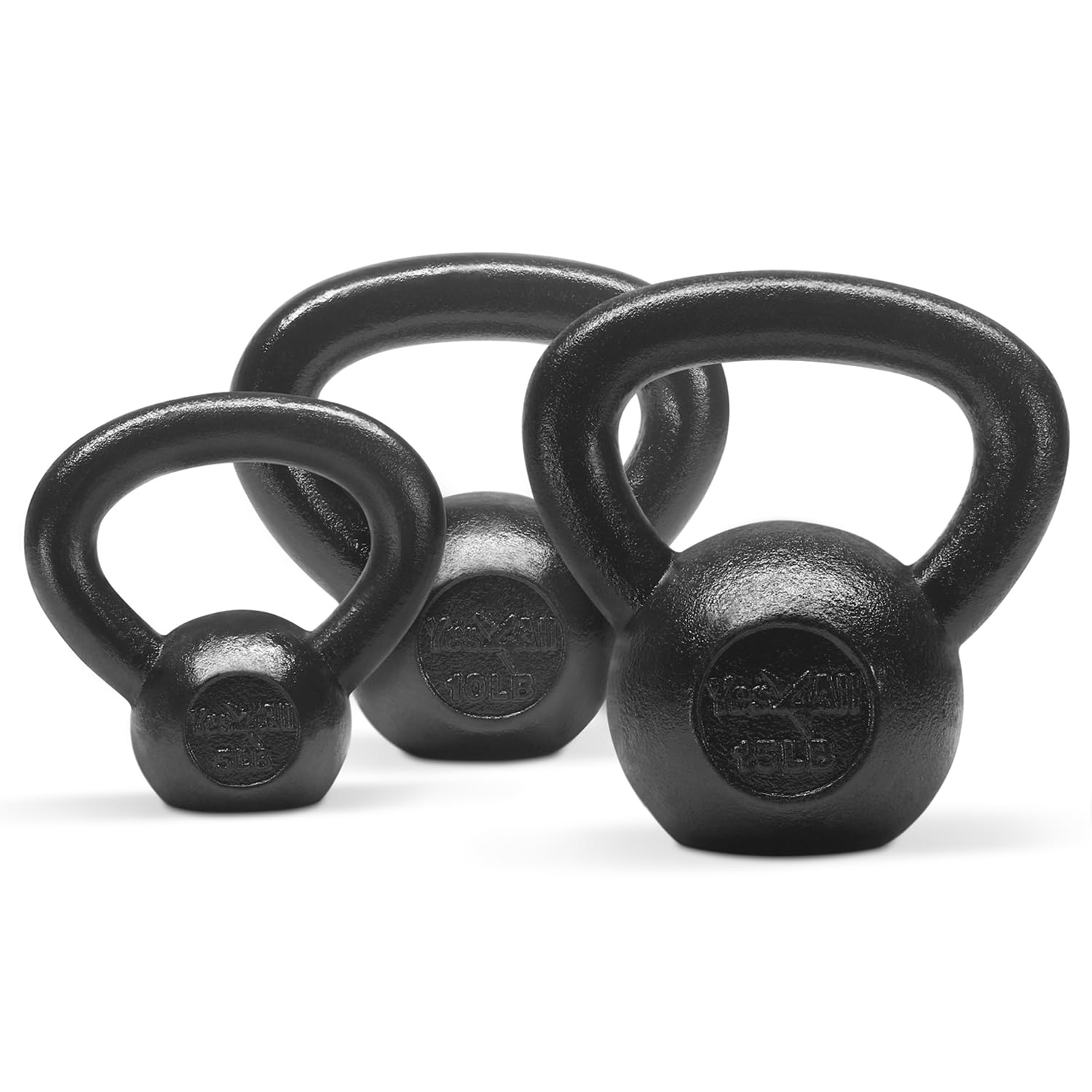
If the plan is a corner of a room and a set that lives on its own stand, this is the one we point to: 5, 10, and 15 pounds, plus a rack that keeps them off the floor and out of the way. The shell is HDPE over a concrete core, which wipes clean and doesn't need the care cast iron does.

The handles are wide enough for two hands and the grip doesn't slip, which is more than the price suggests. What we noticed in use is the volume — these bells are noticeably larger than cast iron of the same weight, so a 15-pounder takes more room between your legs in a swing than you expect, and the rack needs a wider footprint than the poundage implies.

Two things to check when the box lands. Look over every base before the return window closes, since a cracked shell or loose concrete is the failure mode on cement-filled bells. And put one on a scale if a program depends on exact numbers, because the marked weights can read light. The rack and the price still make this an easy first set — for light pressing and squatting, not for a household where 25 pounds is the working weight.

Pros

  • Three bells plus a storage rack
  • Wide handles that take two hands
  • HDPE shell wipes clean

Cons

  • Bulky for their weight
  • Shells can arrive cracked
Our verdict

We recommend it as a first set for light pressing and squatting: three bells, a rack, and a price that makes starting easy.

Check Latest Price
7

Shared Home Gyms

bintiva 7-Piece Set

92 /100
Peggy's Score Outstanding

Key details

Base
Protective rubber pad
Coding
Color coded by weight
Coating
Vinyl over cast iron
Set Includes
5, 10, 12, 15, 20, 25, 30 lb
Check Details on Amazon

Seven bells from 5 to 30 pounds, each one color coded by weight so you can grab the right one without reading a number mid-set. In a household where two people train at different levels, that small feature earns its keep.

Cast iron under a vinyl shell, with a rubber pad on the bottom that stops the bell rolling and keeps the coating off your floor. The handles are deliberately left uncoated, which we appreciate — vinyl turns tacky once your hands warm up, and a bare handle takes a little chalk and holds.

The set stops at 30 pounds, so it's a full beginner-to-intermediate range rather than a lifter's set, and you pay a premium for the spread and the color coding. What that premium buys is a household where nobody waits: seven bells on the floor, warm-up weight through working weight, and no plates to swap between turns.

Pros

  • Seven bells from 5 to 30 lb, color coded
  • Uncoated handles stay grippy
  • Rubber base protects floors and stops rolling

Cons

  • Premium price for a set that stops at 30 lb
  • Seven fixed bells take real floor space
Our verdict

We like it for a shared home gym: seven color-coded bells with uncoated handles and rubber feet, from warm-up weights to a 30-pound working bell.

Check Latest Price
8

Light Daily Work

Yes4All Cast Iron 5/10/15

91 /100
Peggy's Score Outstanding

Key details

Finish
Black paint coat
Handle
Wide and smooth
Material
Cast iron
Set Includes
5, 10, 15 lb
Check Details on Amazon

For about what a cement-filled starter set costs, Yes4All sells the same three weights in cast iron: 5, 10, and 15 pounds with a wide, smooth handle and a flat bottom. When the choice is concrete in a plastic shell or iron at the same money, we take the iron.

The handle is the part you actually touch and it's done properly — wide enough for two hands, smooth rather than rough, no seam to rub a callus. The flat base sits still for renegade rows, and the black paint coat wipes down. Expect the paint to chip where a bell gets set down hard; that's cosmetic on cast iron and, at this price, no surprise.

Three bells is a start, not a program. Fifteen pounds is a press-and-squat weight for most adults and light for a swing, so plan on adding a 20- or 25-pounder before long. The price makes that easy to justify, and it's why this short ladder is still worth owning.

Pros

  • Cast iron at a budget price
  • Wide, smooth, seam-free handle
  • Flat base sits stable for floor work

Cons

  • Tops out at 15 lb
  • No storage rack included
Our verdict

We recommend it as a first purchase: cast iron at cement-set prices, with a handle that's genuinely pleasant to hold.

Check Latest Price

How We Tested Kettlebell Sets

We started with a few dozen sets and singles sold online, then cut anything that duplicated a weight range we already had, skipped listings with no information about handle or coating, and looked at price per pound rather than sticker price. That narrowed things to 12 sets, which we used for six months in a garage gym and in the corner of a spare room, rotating them among me and two training partners with very different hand sizes and experience levels.

In practice, that meant 20-minute circuits of swings, cleans, presses, goblet squats, and carries — the moves people actually do at home. We timed weight changes with a stopwatch in the middle of a circuit to see what a dial or a pin really costs you mid-workout, and we chalked up and kept going to find out which handles turned slick first.

Every bell and every adjustable setting went onto a kitchen scale and got compared to its label, since being a pound or two off matters more than most people expect at the light end. We measured grip diameter with calipers, ran a thumb around the seam where the handle meets the bell looking for casting burrs, and then set each one down hard on concrete to see which powder coats, neoprene sleeves, or HDPE shells chipped, scuffed, or dented over the following weeks.

For size, we measured footprint and checked whether a set fit under a bench or onto its included rack without swallowing the whole room. Value came last: we compared cost per pound across the full range each set covered, because a cheap 10-pounder doesn't help much if the 35 you actually need costs double.

How to Choose a Kettlebell Set

Fixed Bells or One Adjustable

An adjustable bell buys a rack's worth of weights in a single footprint: the BowFlex covers six settings from 8 to 40 pounds, the Yes4All seven from 7.8 to 40. The trade is shape and speed. An adjustable body is taller and boxier than its weight implies, which shows up in cleans and in passing the bell under a leg, and settings either turn on a dial or get loaded by hand.

If cleans, snatches, and long sets of swings are the point of your training, buy fixed cast iron — the handle and the shape are why people keep these for decades. If you train in a room you also live in and will stay under 40 pounds for now, one adjustable covers more ground in less space.

Buy for the Weight You'll Need in Three Months

Starter sets cluster at 5, 10, and 15 pounds, which are pressing and squatting weights. Most adults swing heavier than they press, so a set that tops out at 15 pounds gets outgrown fast. We look at the top of the range first and work backward: 25 pounds covers a beginner's first stretch, 40 to 53 pounds covers most home lifters for years.

Increments matter as much as the ceiling. Five-pound gaps suit pressing, where a 10-pound jump changes the movement; the 12-to-20 step inside an adjustable ladder is a big swing change. If the ladder you're considering skips a weight you'll need, the money is better spent on a set with more rungs.

The Handle Decides Whether You'll Use It

You touch the handle and nothing else, so it deserves more attention than the poundage. A grip diameter around 28 to 30 mm suits most hands, the opening has to clear two hands in a swing, and a casting seam or a rough edge will find a callus inside one set.

Finish matters too. Powder coat grips without chalk, bare cast iron wants some, and vinyl or plastic coatings turn slick once your hands warm up — the reason a coated handle can feel unsteady by the tenth rep while the bell itself is fine.

Cast Iron, Cement, or Composite

Cast iron is dense, so a 25-pounder is compact and a dropped one survives with a chip. Cement in an HDPE or vinyl shell costs less and is much bulkier for the same weight, which changes how a swing feels and how much room the set takes. A cracked shell or a separated base is the failure to watch for, so inspect every bell the day it arrives.

Adjustable bells are composite or plate-stacked, and none of them should be dropped, indoors or out. Set them down under control, and keep the loading mechanism clean on plate-style models so the lock keeps engaging.

Storage, Floors, and the Space You Have

A set of three or five bells needs somewhere to live. A rack keeps them off the floor and makes the set feel like furniture instead of clutter, and measuring the footprint before you buy matters most with cement sets, which are wider than their poundage suggests.

Cast iron is fine to set down on hardwood and bad to drop on it; neoprene and vinyl coatings are kinder and quieter in an apartment. A rubber mat under the training area covers both cases and saves the argument with whoever owns the floor.

Frequently Asked Questions

Final Verdict

For most people setting up a home gym, the BowFlex SelectTech 840 is the set to buy. Six weights from 8 to 40 pounds in one footprint, a dial that takes you from press to swing without breaking rhythm, and a two-year warranty make it the easiest recommendation here — provided you have somewhere to set it down rather than drop it.

If you already know kettlebells are permanent, the REP set's handle and 9-to-53-pound range are worth the money, and Unipack's five powder-coated bells will carry a beginner from 5 to 25 pounds for about a third of that.