Best Neck Stretchers of 2026

A neck stretcher looks like an odd piece of plastic until your shoulders are up around your ears. The appeal is simple: lie back, let the curve support your neck, and give tight muscles a chance to lengthen without forcing a stretch you'll regret. The difference between models is real. Some feel painfully hard within seconds, others barely create traction, and a few are flimsy enough that daily use seems optimistic. The right one turns a few minutes on the floor into a repeatable reset for neck and upper-back tightness.

I've become picky about these, and over five months my team and I have used 14 neck stretchers before work, after screen sessions, and on weekends when my posture has gone sideways. We watched for pain relief and a good stretch, not just pressure under the neck. We also noted comfort, firmness, how well each kept its shape, and value. A neck stretcher won't replace physical therapy, but the right one can make daily tension feel more manageable. The picks below are the ones we kept reaching for.

1

Best Overall

RESTCLOUD Neck and Shoulder Relaxer

86 /100
Peggy's Score Excellent

Key details

Type
Floor cervical traction pillow
Weight
8.78 oz
Material
Polyurethane foam
Dimensions
8.7 x 6.9 x 4.9 in
Check Details on Amazon

A molded foam arc and a ten-minute floor session are all this neck stretcher asks of you, and that simplicity is why it stayed at the top of our list. We spread a mat, lay back, and let the curve settle under the neck; the shape gives both a vertical lift and a horizontal cradle, so you feel the stretch without adjusting a strap or pump. It is not a soft pillow. The polyurethane foam is firm enough to make the first minute feel like work, and that firmness is the point.

What makes the RESTCLOUD useful is that it does not try to be a chair, a massager, or an all-night pillow. The instructions call for a hard floor or mat, not overnight use as an ordinary pillow, and that matches how it behaves in practice: the floor gives the arc something to push against, while a soft bed would let the whole thing sink. We like the 8.78-ounce weight for storage; it disappears on a shelf. If you have a low tolerance for pressure, start with a folded towel over the foam and a shorter session, then build up.

The pros list is short and honest: a strong stretch, compact storage, and no setup. The single size is the main fit caveat. It can feel broad for a shorter neck, so if you are petite, check the return policy or plan to use a towel to fine-tune the contact. Neither issue is a reason to skip it if you want a straightforward daily stretch; they are reasons to start slowly. What keeps it in the top spot is not a feature but the fact that it asks for no batteries, no helper, and no learning curve.

Pros

  • Strong cervical stretch in ten minutes
  • No setup, batteries, or helper
  • Compact 8.78-ounce foam arc

Cons

  • Single size runs large for shorter necks
Our verdict

For a simple ten-minute floor routine, the RESTCLOUD is the neck stretcher we reach for first; its firm arc and single size are the trade-offs.
Check Latest Price
2

Best Adjustable

Lumia Wellness Cervical Traction Block

86 /100
Peggy's Score Excellent

Key details

Type
3-height traction block
Weight
2.82 oz
Material
Closed-cell EVA foam
Dimensions
8 x 4.5 in
Check Details on Amazon

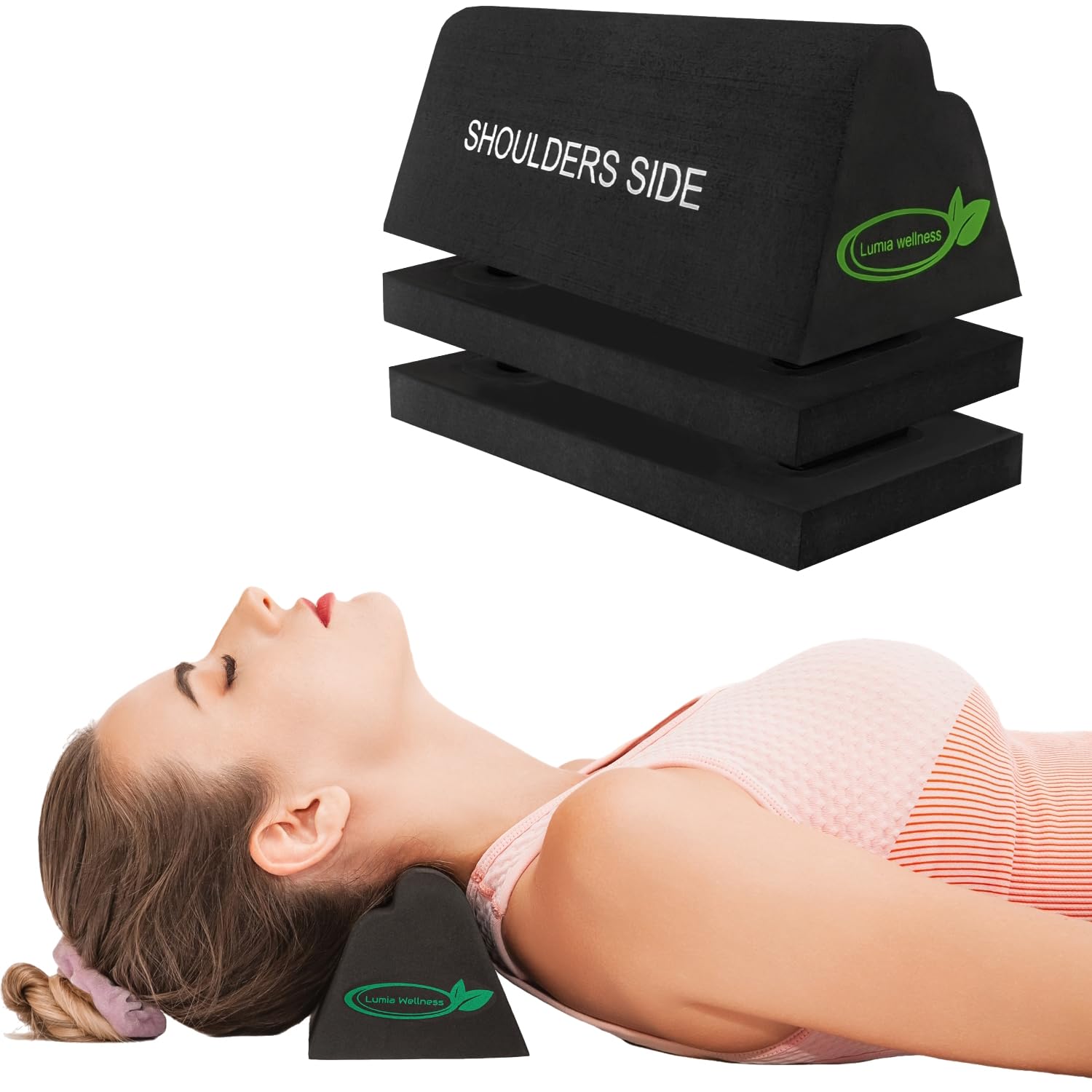
Three stackable wedges change the height, and that is the feature to understand before anything else. The Lumia block is 8 inches long and 4.5 inches wide, with a narrow profile that lets you place the curve along a specific part of the neck. It weighs 2.82 ounces and comes apart into three pieces, so storage is simple. The foam is closed-cell EVA, which is dense and firm rather than soft.

We think that adjustability earns it a place as the best block here for a targeted stretch. On the lowest setting, the curve still feels serious; adding a layer changes the angle and the amount of pressure, so you can find a setting that fits your neck instead of accepting one fixed arc. The narrow width is a real advantage for pinpointing the base of the skull or the mid-cervical area. The foam is unapologetically firm, which is the point, but it is not a cozy first experience.

The pieces fit together simply, and the block is small enough to leave on a shelf. We wish the shape had a little more width for broader shoulders, but that would trade away the pinpoint feel. Start on the lowest setting, use a thin towel if the edge bites, and give it a few short sessions before you judge it. If you want a single arc that asks nothing of you, the RESTCLOUD is easier; if you want to change the height and target a spot, this is the one.

Pros

  • Three height settings change the stretch
  • Narrow profile targets the neck
  • Lightweight at 2.82 ounces

Cons

No notable drawbacks to flag.

Our verdict

We choose the Lumia when you want to change the height and target a specific part of the neck; it is the most adjustable block here.

Check Latest Price
3

Best Premium Home Traction

ComforTrac-Deluxe Home Cervical Traction Kit

82 /100
Peggy's Score Excellent

Key details

Type
Home cervical traction kit
Weight
7 lb
Includes
Carrying case
Incline Angles
10, 15, 20 degrees
Check Details on Amazon

The ComforTrac kit arrives as a frame, a padded headrest, a hand pump, and a carrying case. The frame sets the incline at 10, 15, or 20 degrees, and the pump controls the pull; the headrest is memory foam. At 7 pounds, it is a piece of equipment rather than a pillow you tuck on a shelf.

We set it up on a table, strapped in, and used the pump to build traction gradually. The marked angles make it easier to repeat the same session, and the case means it can be put away between uses. The separate neck wedges adjust the fit around the head, so the pull feels centered rather than like a generic collar.

We think this is the pick for someone who wants a more deliberate home traction session and does not mind a setup. The marked angles and pump give you a repeatable pull, and the case keeps it contained. It is the most involved device here, so it suits a buyer who will leave it set up rather than drag it out daily. For a simple daily stretch, the RESTCLOUD is easier; for a measured, adjustable pull, this is the one.

Pros

  • Repeatable 10, 15, 20-degree incline
  • Hand pump controls traction gradually
  • Memory foam headrest and carry case

Cons

  • Pump failures can make the kit unusable
Our verdict

We keep the ComforTrac for the buyer who wants a clinic-style, repeatable traction session at home and will trade simplicity for control.

Check Latest Price
4

Best Portable Hammock

The Original Neck Hammock

84 /100
Peggy's Score Excellent

Key details

Type
Portable neck hammock
Weight
9.12 oz
Strap Length
100 cm
Package Dimensions
9.41 x 7.32 x 3.66 in
Check Details on Amazon

The Neck Hammock is the device here that changes your relationship with gravity: you hang the straps over a door, settle your head into the cradle, and let the weight of your head create the pull. We found it gentler than a foam arc and easier to tolerate for a first session, with 100 cm straps that let you set the height. It weighs 9.12 ounces and packs into a small package, so it is the one that travels.

We hung it over a door, adjusted the 100 cm straps, and settled in. The pull changes with how far you sit back, so you can start gently and add a little more by leaning away. The fabric is soft, and the design keeps pressure off the front of the neck. It is a different sensation from a foam block: less direct pressure, more of a long, easy pull.

We like this for a traveler or someone who wants a hands-free decompression session without lying on the floor. It is not the deepest stretch in this group; the pull is subtle, and some necks may want more. If you want a strong, fixed arc, the RESTCLOUD is more direct; if you want portable, gentle traction, this earns its place.

Pros

  • Gentle gravity-assisted pull
  • 100 cm straps adjust height
  • Packs small for travel

Cons

  • Setup needs a door and correct seat height
  • Clip and strap are wear points
Our verdict

The Neck Hammock earns our pick for portable, gentle traction when you have a reliable door and want your hands free; it is not the strongest stretch here.

Check Latest Price
5

Best Assisted Stretch

WIDREST Neck Stretcher Strap

87 /100
Peggy's Score Excellent

Key details

Type
Strap with chin belt
Weight
10.2 oz
Material
Polyester
Dimensions
13 x 3 x 1 in
Check Details on Amazon

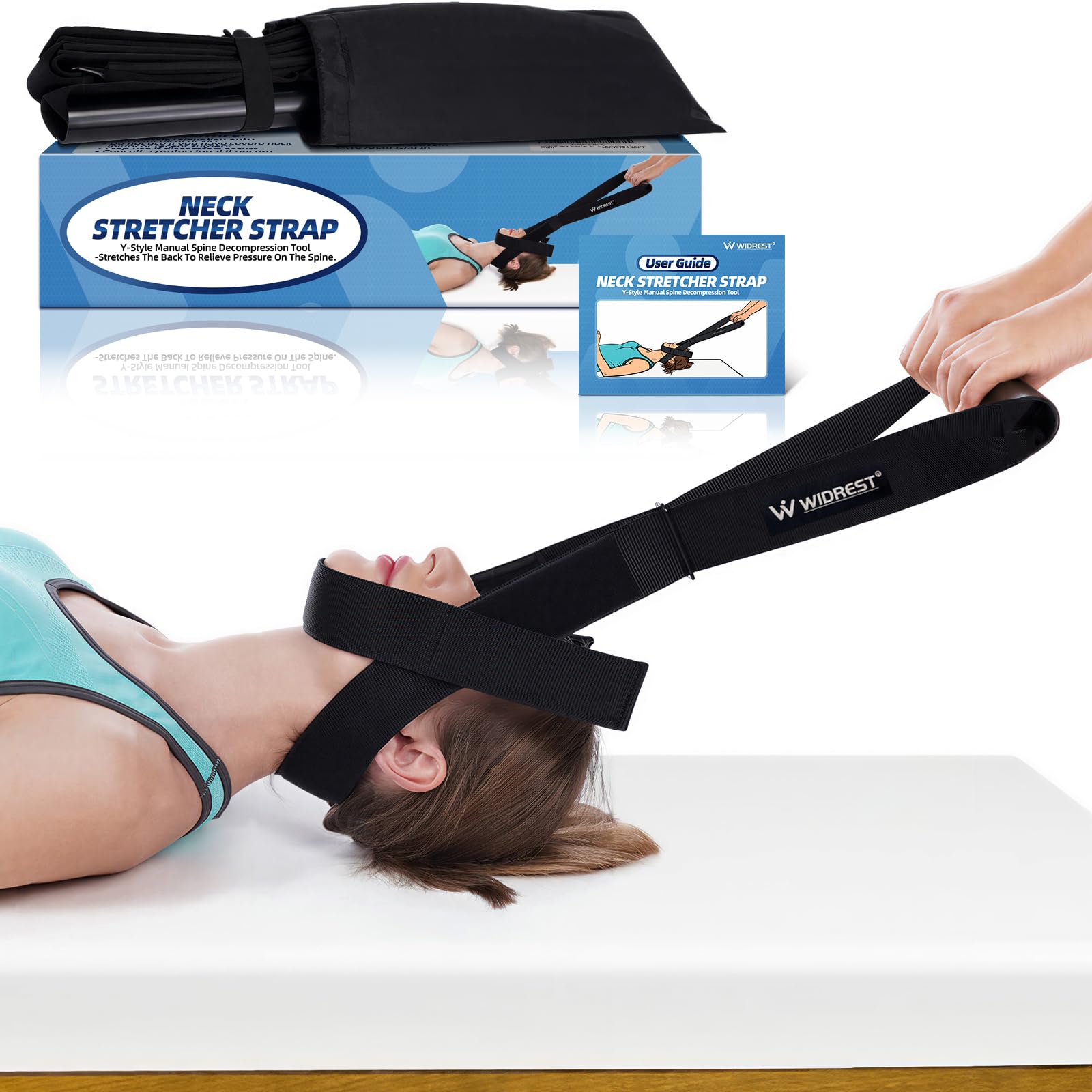
The WIDREST is a polyester strap with a chin belt at one end and a loop for a helper at the other. It measures 13 by 3 by 1 inches and weighs 10.24 ounces, so it rolls up smaller than a foam block. The hook-and-loop closure sets the chin belt, and the strap is hand wash only.

We think this is the best assisted stretch in the group. With a partner at a fixed table, the pull comes in a straight line and the chin belt keeps the pressure centered instead of letting the strap ride up. You control the amount by how hard the helper pulls, which makes it easy to start light. It is also the most social device here: someone has to stand with you, and that is not a flaw so much as the design.

We liked the small packed size and the simple chin belt. The pull is controlled, and you can start light. If you want a solo routine, the RESTCLOUD or the Lumia block is easier. If you have a willing partner and want a controlled pull, this is the one.

Pros

  • Controlled pull with a chin belt
  • Packs smaller than a foam block
  • Easy to start with light tension

Cons

  • Hook-and-loop can slip under a strong pull
Our verdict

Our pick for a controlled, assisted neck pull is the WIDREST, provided you have a partner and a solid anchor; it is not a solo routine.

Check Latest Price
6

Best Inflatable for Chin Support

AUVON Inflatable Neck Stretcher

83 /100
Peggy's Score Excellent

Key details

Size
L
Type
Inflatable chin-up collar
Neck Fit
14–16.5 in
Chin Angle
15 degrees
Check Details on Amazon

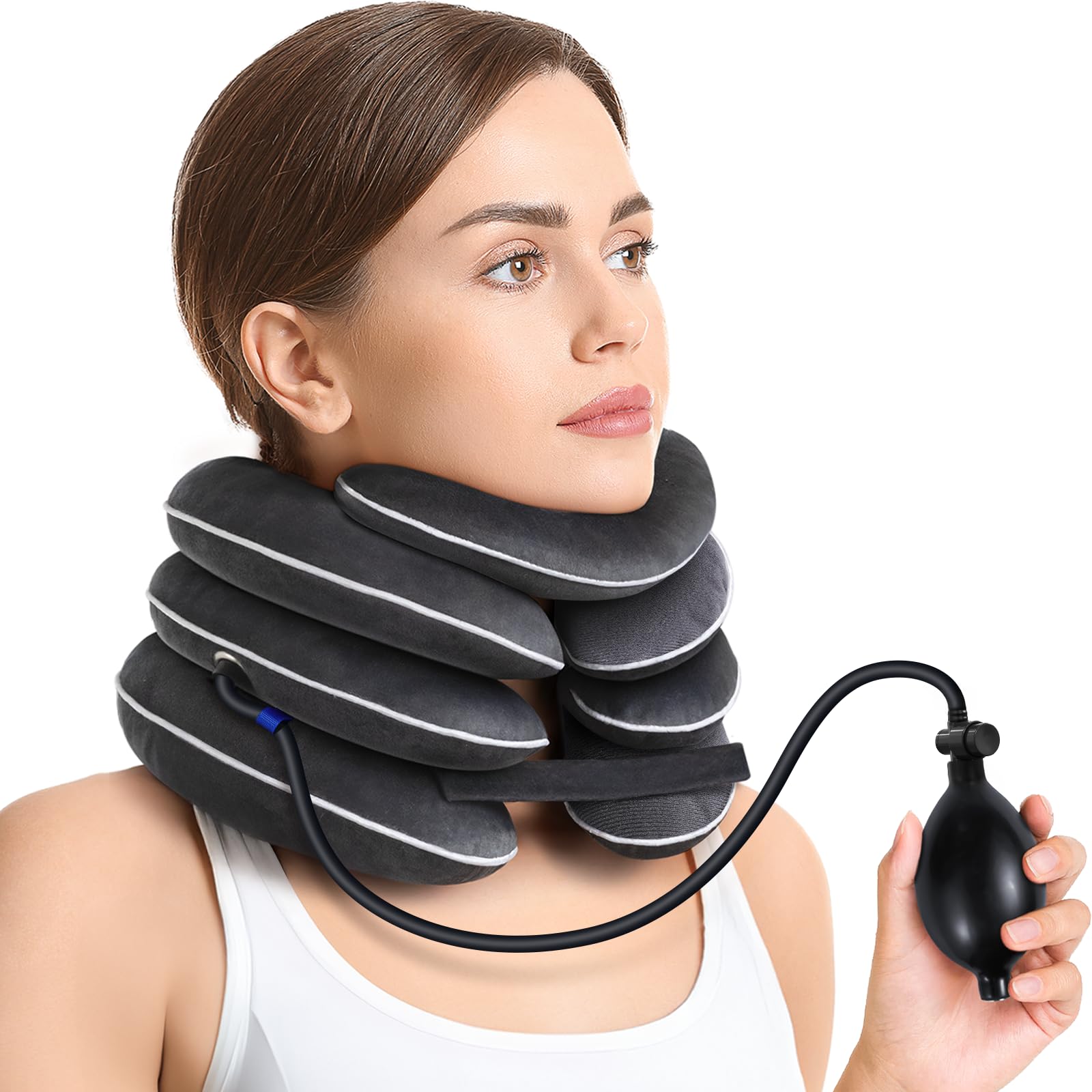
The AUVON is an inflatable collar with a chin-up shelf and a 15-degree angle. The L size is cut for necks measuring 14 to 16.5 inches, and the triple-layer construction combines a PVC air chamber with high-density foam. It weighs 13.05 ounces and packs down when deflated.

We inflated it until the chin support lifted and the collar pressed evenly around the neck. The chin-up shape is the feature that separates it from a basic inflatable: it holds the head from underneath, so the stretch feels more like a gentle lift than a squeeze. The wider base adds support, and the foam keeps the front edge from digging in as much as a bare air bladder.

We think this is the inflatable to choose if you want chin support and a more targeted decompression session. The 15-degree lift is the reason to pick it over a simple air collar, and the foam front is kinder to the jaw than a bare bladder. Start with less air and add pressure slowly; overinflation is what turns a lift into a squeeze.

Pros

  • Chin-up shelf adds support
  • 15-degree lift targets the neck
  • Foam front softens the edge

Cons

  • Fit is limited to 14–16.5-inch necks
Our verdict

We point inflatable shoppers to the AUVON when they want chin support and fall within its stated neck range; check that fit first.

Check Latest Price
7

Best Electric Collar

Air Collar Neck Traction Device

79 /100
Peggy's Score Very Good

Key details

Type
Electric neck traction collar
Chin Pad
Memory foam
Neck Fit
13.7–16.8 in
Traction
Up to 20 lb
Check Details on Amazon

The Air Collar is a seated traction device with an electric pump, two side knobs, and a memory foam chin pad. It fits necks from 13.7 to 16.8 inches and can build up to 20 pounds of traction. The collar sits on the chest and shoulders rather than hanging from a door, so it is a different kind of session from a floor arc.

We wore it in a chair and used the pump in short bursts. The knobs adjust the angle on each side, and the air chambers press from behind the neck; the chin pad keeps the front edge from biting. It is the most hands-off device here once it is on, because you are not pulling a strap or changing foam layers.

What we noticed is how much the collar changes the session: you sit upright, the pump does the work, and the traction comes on gradually. The memory foam chin pad is a thoughtful touch, and the side knobs let you fine-tune the angle without guessing. It feels more like a piece of equipment than a pillow, which is the point.

We think the Air Collar is the pick for someone who wants seated, adjustable traction and does not mind a larger device. It is the most controlled electric option here. The trade-offs are real: it is bulky around the shoulders and needs charging. If you want something you can toss in a bag, the AUVON or the RESTCLOUD makes more sense. For a desk-side traction routine, the Air Collar earns its place.

Pros

  • Electric pump adjusts traction gradually
  • Up to 20 pounds of seated traction
  • Memory foam chin pad

Cons

  • Fit stops at 16.8 inches
Our verdict

For seated, electric traction within its stated neck range, the Air Collar is our pick for pump-controlled adjustment.

Check Latest Price
8

Value Floor Stretch

ComfortLife Neck Stretcher

83 /100
Peggy's Score Excellent

Key details

Type
6-point floor stretcher
Weight
12.4 oz
Material
High-density foam
Dimensions
8.5 x 6.5 x 4.5 in
Check Details on Amazon

The ComfortLife is a foam arc with six raised points and a C-curve, measuring 8.5 by 6.5 by 4.5 inches and weighing 12.35 ounces. It is made from high-density self-skinning foam, so the surface is firm and smooth rather than soft. The points are placed to press along the neck and lower head.

We used it on a mat and felt the difference the points make: instead of one broad curve, the pressure lands in smaller spots. That can be useful if you want a more focused stretch, and it is also why the device feels busier than a smooth arc. The foam is dense enough that it does not collapse under the head.

Against the RESTCLOUD, this one is a little more shaped and a little less neutral. The six points give you more feedback, but they also make the first session feel more aggressive. It is a good option if you have used a smooth arc and want more targeted pressure; it is not the gentler introduction.

We think the ComfortLife earns a place as the value floor alternative, especially if you want a more contoured feel than a plain arc. The six-point shape is more focused, but it is also less forgiving than a smooth curve. If you want the simplest default, the RESTCLOUD is still the easier call; if you want a sculpted stretch and do not mind a firmer feel, this is worth a look.

Pros

  • Six points focus pressure
  • Dense foam supports the neck
  • Contoured alternative to a plain arc

Cons

  • Foam can warp out of shape
Our verdict

We like the ComfortLife as a lower-cost floor stretcher for a buyer who wants a more contoured, six-point feel rather than a smooth arc.

Check Latest Price

How We Tested 14 Neck Stretchers

We started by rounding up the neck stretchers shoppers actually talk about, then cutting anything with sharp seams, vague sizing, or a design that forced the head into one fixed angle. That left 14 units across a range of prices, from soft foam cradles to firm arch-shaped devices and adjustable models. Each one went through five months of regular use.

They lived where neck tension actually shows up: beside the couch after work, on the bedroom floor before bed, and near the desk during long screen days. We began with five-minute sessions, then worked up to ten minutes, noting whether we could relax our shoulders or spent the whole time waiting for it to end. To judge hardness and firmness, we paid attention to where pressure landed in the first 30 seconds and whether the device felt supportive or punishing. We checked neck traction by seeing whether the head dropped back or the chin tucked, and comfort by whether we wanted to stay past the timer.

For neck support and stretch, we started each session with the same kind of tension—after a morning of email or an evening of phone scrolling—and compared how loose the neck felt afterward. Posture support got tested after desk work, when we noted whether we could sit taller rather than just whether something cracked. Durability meant wiping each one down, packing it for weekend use, and looking for dents, peeling, or foam that stayed compressed. Value came down to whether a model did something the cheap ones couldn't.

How to Choose Neck Stretchers

Start with the setup you will repeat

The device you choose should fit the way you already sit or lie down. A floor arc such as the RESTCLOUD is the least fuss: you put it on a mat, lie back, and stay for a short session. A strap like the WIDREST needs a helper and a fixed anchor, while a hammock like the Neck Hammock needs a door and a chair at the right height. An inflatable or electric collar lets you sit upright, which suits a desk or a reading chair.

We rank setup first because a device that takes two minutes to arrange is a device you will skip. If you want a solo habit, choose a floor arc or a seated collar. If someone can help you two or three times a week, the strap gives a controlled pull that is hard to match with foam.

Treat firmness as part of the fit

Foam stretchers are meant to be firm; if the arc gives way under your head, it stops creating the angle that makes the stretch useful. That does not mean you have to start at full pressure. A folded towel over the foam softens the edge, and an adjustable block like the Lumia lets you begin on the lowest of its three heights.

Inflatables work differently: you add air until you feel support, then stop. More air is not better, especially around the jaw. The useful test is whether you can breathe and relax your shoulders while the device holds you; if you are bracing, let some air out or take a layer off the block.

Check the neck range before you buy

Seated collars are the most size-sensitive devices here. The Air Collar lists a 13.7-to-16.8-inch neck range, and the AUVON L size lists 14 to 16.5 inches. Measure around the middle of your neck and compare before ordering; a collar that is too small pinches, and one that is too large slides instead of lifting.

Foam arcs are usually one size, but that does not make them universal. A shorter neck can find a full-size arc too broad, while a longer neck may want a taller curve. A strap or hammock has more adjustment, but it depends on the anchor and the person pulling. Fit is not a detail you can fix later with enthusiasm.

Keep sessions short and stop if something changes

These devices are for short sessions, not overnight sleep. The RESTCLOUD instructions call for a hard surface and warn against using it as an ordinary pillow all night, and that is a sensible rule for any stretcher here. Start with a few minutes, build slowly, and keep the session brief enough that you can relax into it.

Stop if you feel sharp pain, numbness, tingling, or dizziness. A stretch should feel intense but controlled, not like a nerve is being pinched. If you have a recent neck injury, surgery, or a diagnosed spinal condition, ask a clinician before you start traction at home.

Look at the parts that wear

The more parts a device has, the more places it can fail. Pumps, valves, clips, and hook-and-loop closures are the wear points on inflatables, hammocks, and straps; a foam arc has almost nothing to break. That does not make foam better for every neck, but it does make it the lower-maintenance choice.

Before you buy, check the return window and inspect the device when it arrives. A pump that will not hold pressure or a strap that slips is not a technique problem; it is a reason to exchange the unit. Store inflatables deflated and straps dry, and keep the instructions with the device.

Frequently Asked Questions

Final Verdict

The RESTCLOUD is the neck stretcher we recommend first because it turns a ten-minute floor session into the path of least resistance: no pump, no strap, no helper. Its firm arc is the thing to respect, and the single size is the thing to check.

If you want to change the height and target a specific part of the neck, the Lumia block is the better buy. Start with the RESTCLOUD unless adjustability matters more than simplicity.